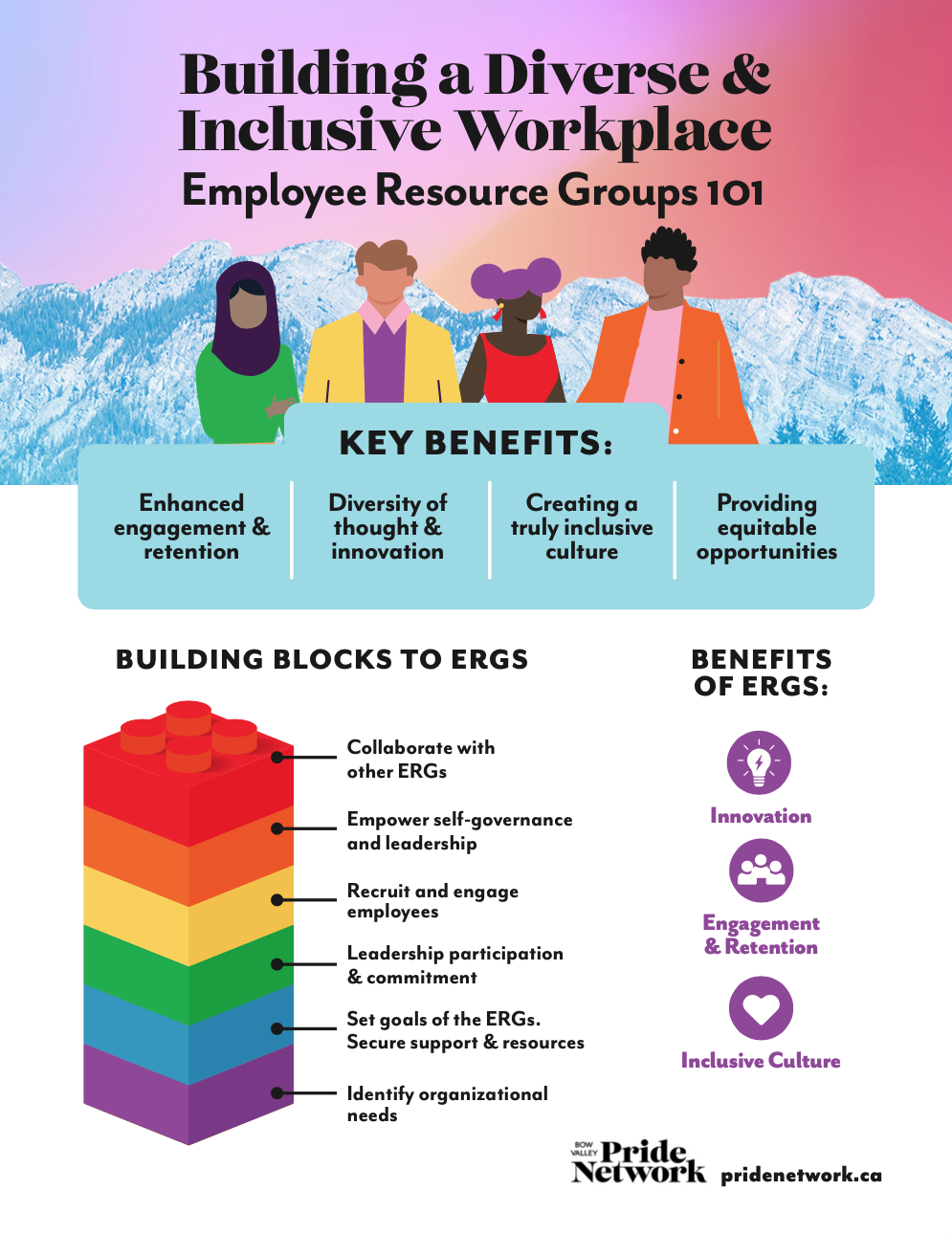
Employee Resource Groups 101
Employee Resource Groups (ERGs) or Affinity Groups are voluntary, employee-led communities within organizations that promote diversity, equity, and inclusion (DEI) by bringing together individuals with shared characteristics, interests, or experiences.
These groups serve as platforms for networking, professional development, mentorship, and advocacy. These functions are particularly important for equity-deserving groups, as members of these groups are often not able to access these professional opportunities otherwise. Typically, ERGs meet monthly to connect, share experiences, and support the success of the group’s members
ERGs also foster a sense of belonging and empowerment among employees. When employees feel a sense of belonging and empowerment, they can spend more of their mental energy on doing good work, and less energy having to focus on navigating an organizational culture where they do not feel comfortable or respected.
Business Benefits of ERGs:
-
ERGs often provide a sense of community and support, increasing employee satisfaction, morale, and loyalty. Engaged employees are more likely to stay with the organization, reducing turnover costs and maintaining institutional knowledge and expertise.
-
ERGs foster an inclusive environment where employees feel empowered to share their ideas and contribute to the organization's success. These insights, if harnessed correctly, can help generate innovative ideas and creative problem-solving.
-
ERGs promote a culture of belonging and respect by celebrating diversity and creating opportunities for all employees to thrive. Inclusive cultures lead to higher levels of employee morale, collaboration, and productivity, ultimately contributing to the organization's overall success.
-
By amplifying underrepresented voices and using lived experience to help address systemic barriers, ERGs help create a more equitable and inclusive workplace for all employees.
ERGs are well-established as good for business and employee engagement, but they require planning, resources, and consistency to come to life within an organization and make a positive impact for equity-deserving groups.
ERG Activities:
The purpose of an ERG is to support its members – the mandate of the group can be flexible and evolve with its members needs. Here are some common functions ERGs typically serve in an organization:
Networking & Professional Development
ERGs often organize events that provide opportunities for members to connect, share experiences, and build professional relationships.
These events can be casual, or more formal like hosting educational workshops or training sessions.
Cultural Celebrations
ERGs celebrate cultural heritage and awareness months (such as Black History Month, Pride Month, or Women's History Month) with events like panel discussions, cultural fairs, webinars, film screenings, and more.
Often, the organization will help promote these events to raise awareness and support throughout the organization.
Feeback & Change-making
Often, ERGs are a great resource for information-gathering and feedback. They can serve as a sounding board for organizational leaders by providing feedback on new initiatives, policies, and programs.
These insights can help shape more inclusive and effective strategies
Key Elements of Buildings ERGs:
Identifying organizational needs
First, you need to assess your organization’s needs. This can include a review of employee demographics, interests, and challenges. This can help identify areas where ERGs can provide support and address specific needs.
Common needs that often inspire ERGs involve a equity-deserving group facing barriers in the organization. For example: women not reaching senior leadership levels, BIPOC employees not advancing or getting promoted in the organization, or an organization’s struggle to retain employees with disabilities.
With identified issues like these, common ERGs can look like:
Women’s Leadership ERG
BIPOC Growth ERG
Disability Task Force ERG
Identifying group structure and size
The overall size of the organization and its structure will influence the appropriate size of an ERG.
The ERG should be large enough to reflect the diversity within the organization and to ensure diverse perspectives are included. However, it should also be small enough to allow for effective communication and decision-making.
Typically, larger organizations (500+) people can have multiple ERGs with distinct identity groups, all working towards unique goals that support their identity groups. Smaller organizations can have just a single ERG with a mix of identities that work together towards general inclusion goals.
Identifying the group’s goals:
Once you know what needs you’d like to address and what type of ERGs should be formed, you must define clear objectives and goals for each ERG, outlining the intended outcomes and impact they aim to achieve within the organization.
The best practice for the creation of ERGs is co-creation. Discussions around ERG’s purpose, goals, and mandate should be co-designed with members from the corresponding equity-deserving group. This ensures the group’s needs and perspectives are foundational to the process.
Securing support & resources:
In order for ERGs to have success and longevity, they need both senior leadership support and dedicated resources. Work to secure leadership endorsement and appropriate resources, such as budgetary allocation and staffing support. This helps secure an operational future for ERGs while also demonstrating organizational commitment to ERG initiatives.
Once resources are secured, allocate resources for staff liaisons, who can serve as points of contact and provide guidance and support to ERG leaders and members.
True leadership commitment
When leaders actively support ERGs, it sends a clear message that the organization values diversity, equity, and inclusion.
This often looks like:
Active participation & respect
Leaders regularly attend ERG meetings, events, and activities. Their presence shows they value the ERG’s work and are willing to invest their time.
Participation from leaders involves listening to and understanding new perspectives. Leaders receive the feedback and concerns raised by ERGs and take meaningful actions to address them
Leaders respect the viewpoints shared and the vulnerability required to do so. This feedback should be honored with confidentiality and belief – not questioning the reality or truth of someone’s experience
Advocacy and Sponsorship
Leaders advocate for ERG initiatives at higher organizational levels. They act as sponsors, helping to elevate the group's concerns and initiatives to decision-makers.
This includes consistently communicating the importance of ERGs to the entire organization through various channels, such as company newsletters, town halls, and internal social media platforms.
Policy and Strategy Integration
Perhaps most importantly, leaders help the ERGs take action and effect change within their organization
Leaders ensure that the goals and initiatives of ERGs are integrated into the organization's broader strategy.
This includes setting measurable goals and tracking progress and supporting the work with resource allocation.
Recruiting and engaging employees:
To begin recruiting ERG members, promote ERG membership opportunities through various internal communication channels, including email newsletters, intranet announcements, and social media platforms.
Foster inclusivity and engagement by organizing welcome events, networking opportunities, and educational sessions to encourage active participation and collaboration among ERG members.
Recognize that not every member of an equity-deserving group desires to be a part of the ERG. This can be due to several reasons, including safety and disclosure. Respect anyone’s decision to not participate.
Don’t suggest or require membership for any individual – be sure to make the process wholly optional for everyone.
When you are adding members to the group, it will be impossible to tell just by looking if someone belongs to certain identity groups, so it must be an optional and open invite to the entire org when building the group.
Share the purpose of the group, and then restate that purpose at every meeting. If anyone joined by mistake (thinking it is an interest-based group for example, rather than a group for people within a specific community) they can learn the purpose and step away if it is not right for them.
Empowering self-governance and leadership
For ERGs to succeed, ERG leaders need to be afforded autonomy, support, and training to effectively lead their groups and drive meaningful impact within their communities. This includes time to learn and find an established process, as nothing is perfect when it first begins.
Work with ERGs to establish clear governance structures, including leadership roles, responsibilities, and decision-making processes, to ensure transparency and accountability within ERGs. Do not provide this for ERGs – ensure this is a collaborative process.
Recognize that the structure and goals for the group as originally envisioned may change. ERGs are flexible living groups that will continuously evolve based on the needs of the members.
Moving towards collaboration
Once multiple ERGs are established and functioning successfully, you can consider encouraging collaboration among ERGs, and even other departments within the organization. This can help leverage diverse perspectives and resources for shared initiatives.
Once collaboration is established, you can work to integrate ERG initiatives into broader organizational strategies, such as diversity training programs, recruitment efforts, and community outreach initiatives, to maximize their impact and alignment with business objectives.
Employee Resource Groups (ERGs) play a crucial role in promoting diversity, equity, and inclusion (DEI) within organizations and driving business success. By building and nurturing ERGs, businesses can empower employees and provide an avenue for genuine employee engagement. This work can lay the foundation for creating a culture of belonging and innovation and building a more equitable and inclusive workplace for all.